Product
Six questions every Meta account should be able to answer.
SocialBuster answers them from your own ad data, then gives you the tools to act on each answer.
01 Question 1
What is winning?
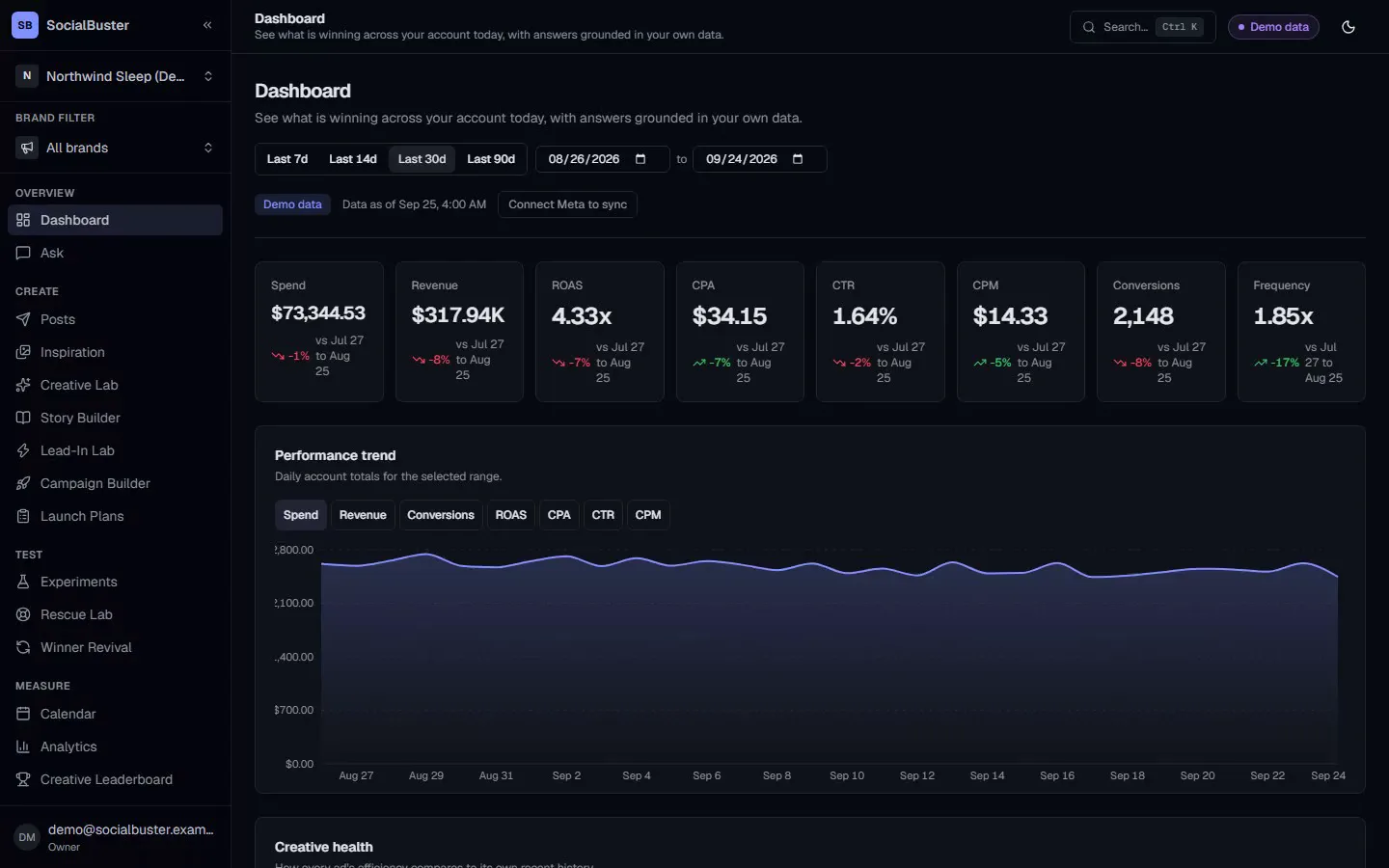
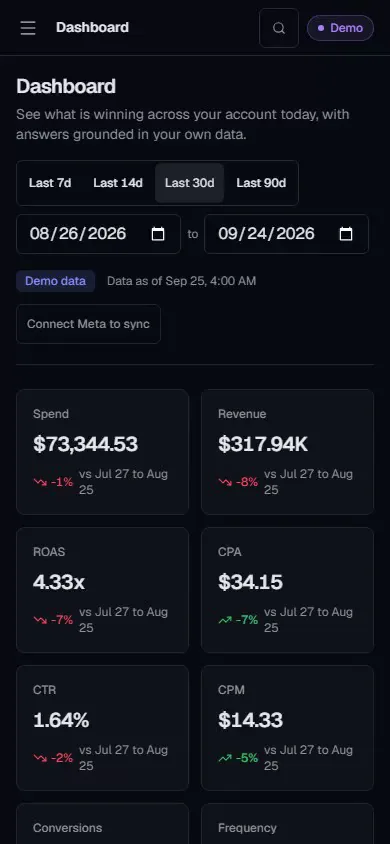
Over the last 30 days (Aug 26 to Sep 24) the demo workspace spent $73,344.53 and returned $317.94K in revenue, a 4.33x ROAS. Of its 62 ads, 50 are healthy, 11 are on watch, 1 is fatiguing and none have fallen far enough to need reviving.
4.33x
ROAS, last 30 days · demo workspace
Fig. 2 · Dashboard, the spend, revenue and ROAS stat row · Northwind Sleep demo workspace, fictional data.
02 Question 2
Why is it winning?
Group any metric by style, hook type, angle, CTA, identity or funnel stage, and Analytics shows which traits are helping and which are hurting, each with a confidence level and the spend and conversions behind it. In the demo workspace, founder photo ads convert at about 1.49x the account's typical rate, a 49% lift across $25,429.91 in spend and 1,218 conversions over the last 127 days (May 21 to Sep 24). Founder Page ads also carry a 48% lower CPA than Brand Page ads over the same window, though that comparison is observational: a lead worth testing, not proof.
Analytics in detail →Fig. 3 · AI Strategist, style efficiency · Northwind Sleep demo workspace, fictional data.
03 Four more questions, one index
The same evidence, answering four more questions.
03
What should I test next?
ShowThe AI Strategist runs nine rule checks over the account's own numbers and ranks what it finds: a fading winner ahead of a minor edge. A claim needs at least $100 of spend and 5 conversions to compare a creative attribute, or $20 of spend and 1,000 impressions in a week to judge a single ad's trend. Below that bar the card reads “not enough data yet”, with the real counts, instead of a guess dressed as insight.
How the Strategist decides →03
What should I test next?
The AI Strategist runs nine rule checks over the account's own numbers and ranks what it finds: a fading winner ahead of a minor edge. A claim needs at least $100 of spend and 5 conversions to compare a creative attribute, or $20 of spend and 1,000 impressions in a week to judge a single ad's trend. Below that bar the card reads “not enough data yet”, with the real counts, instead of a guess dressed as insight.
How the Strategist decides →04
Which apparently losing ads never received a fair test?
ShowRescue Lab finds ads whose lifetime spend stayed under $346.57 (the greater of $20 or 10% of the account's median ad spend), reached fewer than 2,000 impressions, or produced fewer than 3 conversions. In the demo workspace, 7 ads clear that bar on $57.00 of combined lifetime spend, and 2 carry a high conviction rating. “the founder’s DIY note, as a screenshot” spent $6.66 across 490 impressions and shares a third of its creative DNA with the account's proven winners. That does not make these ads losers: a second-chance test gives each one a capped budget and a stop-loss, instead of leaving it buried by algorithmic delivery.
Rescue Lab →04
Which apparently losing ads never received a fair test?
Rescue Lab finds ads whose lifetime spend stayed under $346.57 (the greater of $20 or 10% of the account's median ad spend), reached fewer than 2,000 impressions, or produced fewer than 3 conversions. In the demo workspace, 7 ads clear that bar on $57.00 of combined lifetime spend, and 2 carry a high conviction rating. “the founder’s DIY note, as a screenshot” spent $6.66 across 490 impressions and shares a third of its creative DNA with the account's proven winners. That does not make these ads losers: a second-chance test gives each one a capped budget and a stop-loss, instead of leaving it buried by algorithmic delivery.
Rescue Lab →05
Which winning ads can be revived?
ShowWinner Revival separates an ad's own decline from a shift across the whole account. The demo workspace's founder-story raw photo, “The night before we shipped the first batch,” run under Maya Chen, the demo brand's fictional founder persona, fell 12% in ROAS (from 4.19x to 3.69x) over the last 7 days against the prior 7, while the account's own ROAS rose 3% over the same window, so the decline reads as the ad's own. A revival plan tests new imagery first, then the headline, then the body, and keeps the original running as the control at every stage.
Winner Revival →05
Which winning ads can be revived?
Winner Revival separates an ad's own decline from a shift across the whole account. The demo workspace's founder-story raw photo, “The night before we shipped the first batch,” run under Maya Chen, the demo brand's fictional founder persona, fell 12% in ROAS (from 4.19x to 3.69x) over the last 7 days against the prior 7, while the account's own ROAS rose 3% over the same window, so the decline reads as the ad's own. A revival plan tests new imagery first, then the headline, then the body, and keeps the original running as the control at every stage.
Winner Revival →06
Which hooks, stories, images, CTAs, identities and formats keep generating revenue?
ShowCreative Lab classifies every ad by style, hook, angle, funnel stage and production zone, then measures which of those traits carried the spend. Raw executions return 5.47x ROAS in the demo workspace against 3.44x for middle production and 3.92x for high production, at a 36% lower CPA than middle production. The Creative Leaderboard ranks the specific headlines, images and CTAs behind those numbers: one headline, “Finally, a weighted blanket that does not trap heat,” carries 5 ads and an adjusted ROAS of 8.72x over the last 30 days. Its coverage mode is co-occurrence, not attribution: an ad using several winning elements counts toward every one of them.
Creative Lab in detail →06
Which hooks, stories, images, CTAs, identities and formats keep generating revenue?
Creative Lab classifies every ad by style, hook, angle, funnel stage and production zone, then measures which of those traits carried the spend. Raw executions return 5.47x ROAS in the demo workspace against 3.44x for middle production and 3.92x for high production, at a 36% lower CPA than middle production. The Creative Leaderboard ranks the specific headlines, images and CTAs behind those numbers: one headline, “Finally, a weighted blanket that does not trap heat,” carries 5 ads and an adjusted ROAS of 8.72x over the last 30 days. Its coverage mode is co-occurrence, not attribution: an ad using several winning elements counts toward every one of them.
Creative Lab in detail →
04 Identities, and one calendar
Make and publish as the right identity.
Every draft is written and published as one of your identities, a Brand Page or a Founder Page among them, switched in one click. Every post, campaign and test then lands on one calendar, and every campaign this creates on Meta starts paused: nothing spends until you activate it.
Publishing to Facebook and Instagram from a new account depends on Meta's review of the app, which is in progress.
Publishing in detail →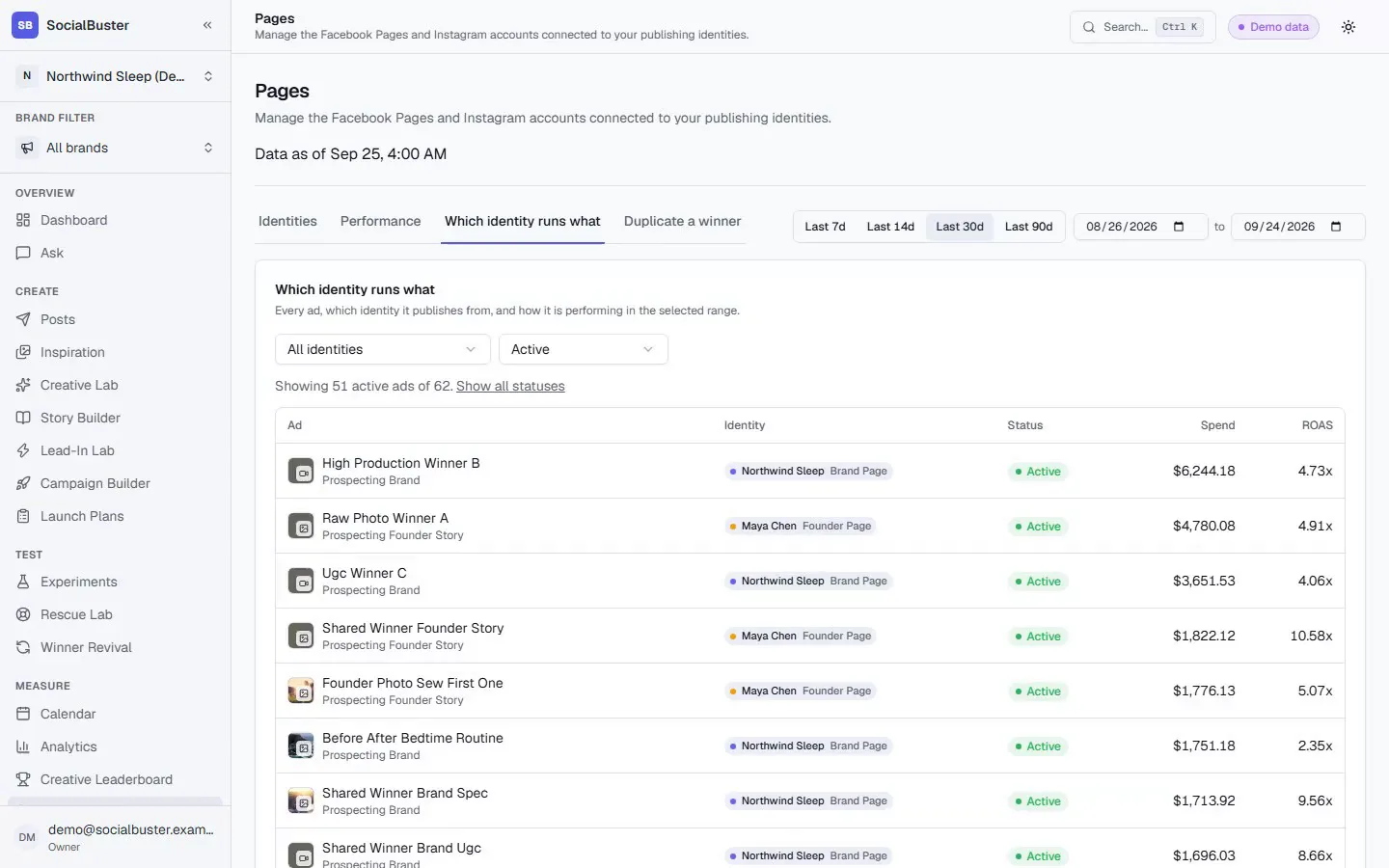
Fig. 4 · Pages, which identity runs what · Northwind Sleep demo workspace, fictional data.
Demo workspace05 Rules
01Every recommendation cites the numbers it rests on, and says so when there are not enough of them.
02Nothing is paused, launched, scaled or published on Meta until a person confirms it.
03AI drafts never invent testimonials, results, numbers or stories. Facts you supplied are marked apart from the AI’s framing.
These are product rules. You can watch each one work inside the app.
06 Connections, and what it will not do
Connects to
MetaShow
Connect a Meta ad account with Facebook Login, and campaigns, ads and daily results sync in resumable rounds. Every pause, launch or publish action is started by a person; syncing pulls data, it never pushes a change.
Meta
Connect a Meta ad account with Facebook Login, and campaigns, ads and daily results sync in resumable rounds. Every pause, launch or publish action is started by a person; syncing pulls data, it never pushes a change.
OpenRouterShow
Text generation runs on hosted AI by default. From Growth, connect your own OpenRouter key and generation runs on your own account and billing instead.
OpenRouter
Text generation runs on hosted AI by default. From Growth, connect your own OpenRouter key and generation runs on your own account and billing instead.
fal.aiShow
Image generation works the same way: hosted by default, or your own fal.ai key from Growth. A key is validated before it is saved and stored encrypted, never sent to the browser.
fal.ai
Image generation works the same way: hosted by default, or your own fal.ai key from Growth. A key is validated before it is saved and stored encrypted, never sent to the browser.
Will not do
01
Change, pause, launch, scale or publish an ad on Meta by itself: every one of those actions waits for a person to confirm it.
02
Invent numbers, testimonials, results or stories: AI copy is checked against the fact sheet you supplied, and anything it could not trace back to a fact is marked as framing, not fact.
03
Claim attribution that Meta does not report: an attribute’s lift is a correlation against the account’s own typical rate, never a per-asset causal claim.
See these six answers for your own account.
Connect a Meta ad account and SocialBuster syncs its campaigns, ads and daily results, or load the Northwind Sleep demo workspace and look around first.